How I built and tested an AI coach for handstands and mobility. The banana is the bug.
fixmybanana.com is a fun little tool with a real model behind it: upload a handstand photo and an OpenAI vision model tells you whether you have "good form" or a "banana back", the arched spine every beginner has.
I was a personal trainer before data science, and I built this the way I learn best: make something, then find out where it breaks. This page is the finding-out, kept as a lab notebook. It answers four questions: what problem the tool has, what I traded off, how it's built and why a vision model is the right tool, and how each version scores on the same 54 photos I labelled by hand. Some of the numbers are bad. That's the point.
1 · The problemA confident answer with nothing behind it
The first version did what most AI demos do: send a photo and a prompt to a model, show whatever comes back in a nice card. Four things were wrong with that, and none of them showed on screen.
Nobody knew if it was right. There was no reference to compare against, so "it seems to work" was the only evidence.
The same photo could get different answers, and nothing measured how often.
It had no way to say "I can't tell". Front views, a plank, a statue: everything got a verdict or a broken message.
It could fail silently. When a billing lapse cut off the model, the site kept returning 200 and the code threw away the reason.
The question this page answers is the one I'd ask about any model in production: how do you know, and what does it cost to find out?
2 · Why AIWhich part needs a model, and which part doesn't
A banana back is a curve in the lower spine. There are two honest ways to find it in a photo, and only one of them is AI in the sense people mean.
pose estimator
vision-language model
what it gives you
joint keypoints, so a hip angle and a threshold
a label, in words, from the whole picture
needs
a clean side view with the body visible
any photo; it judges the look, not the geometry
"not a handstand"
no: it finds a skeleton in anything
yes, if the prompt gives it the option
coaching sentence
no
yes, in the same call
repeatable
yes
measured below: 83% of photos
The part that needs a language model is the coaching and the judgement on messy real phone shots. The angle itself doesn't. So: a vision-language model for verdict and feedback, measured against hand labels, with a pose-estimator baseline planned on the same photos (v4). If the geometry wins on accuracy per cent, it takes the verdict and the language model keeps the coaching. The model has to earn the job on the fixed set.
How a vision model reads a photo
No skeleton, no joint angles. The photo is cut into tiles, each tile becomes a few hundred vectors, and those are appended to the prompt as extra words. The transformer that predicts the next word predicts the verdict. Three things follow, and all three show up in the results.
It sees a gestalt, not geometry. It knows the look of a banana from captioned photos and never measures the hip. A silhouette or a leg split changes the look, not the arch.
The prompt is part of the input. Tell it the photo is side-on and it reads a front view as one. Cap the answer at five tokens and a hedge gets cut mid-sentence.
The answer is sampled. Even at temperature 0, when "good" and "banana" are nearly tied, tiny numerical differences flip the arg-max. Borderline photos wobble; clear ones don't.
Going deeper: image tokens, cost and accuracy
A vision encoder turns each 14- or 16-pixel patch into an embedding; pooling reduces those to a fixed budget per tile (OpenAI bills 170 tokens per 512-pixel tile plus 85 for a downscaled overview). The language model attends over image and text tokens with the same mechanism, so "banana back" in the prompt and the pixels of a lumbar curve compete in the same attention heads. Consequences: resolution is a cost lever (low-detail mode sends only the 85-token overview, about a quarter of the price, worth testing because arch is a coarse feature); fine angular judgements are unreliable by construction; and there is no calibrated probability behind the answer unless you ask for one, which is why v1 requests a confidence with a reason.
3 · The trade-offsDecisions, and what they cost
Each row is a choice, the alternative I turned down, and why. The alternatives aren't wrong, just wrong at this scale.
decision
chose
instead of
why
Reference labels
My hand labels, checked by a second labeller
An LLM as judge
A judge needs 100+ validated labels and drifts. At 54 photos, reading every failure myself is cheaper. Labeller agreement, 66%, is published as the ceiling.
Test set
54 photos chosen along known axes
A random sample of uploads
Random uploads are mostly side-view gym shots; the edges are where it fails. Price: the set doesn't match live traffic, which monitoring (v5) is for.
Photo source
Creative Commons + 5 marked synthetic
Students' photos, or 200 generated ones
The set is public, so it can only hold images I may republish. Synthetic images leak the label into the pixels; kept to the two axes Commons can't supply.
Target
Binary label first, 0–10 score next (v1)
A score from the start
Measure what shipped. The binary turned out noisier than it looks; the score is the fix, and the eval will show by how much.
Repeats
5 runs per photo
1 run, or 20
One run hides the wobble; 20 costs four times more for a spread that barely tightens. Whole run: $1.24.
Model
gpt-4o at full image detail
A cheaper model or low-detail mode
Change one thing at a time. Model and detail get their own row (v4), with cost and latency beside accuracy.
Privacy
Uploads deleted after 24 h, no pixels logged
Keeping uploads to build a real-traffic set
The privacy note on the home page has to stay true. Monitoring will log numbers per upload, not images.
Deployment
Main is production, PR is the gate
A staging environment
For one developer, a PR plus one-click rollback is the cheaper net. The gap it leaves gets a daily end-to-end check.
4 · The solutionA vision model for the verdict, measured on a fixed set before anything changes
One upload triggers up to two calls to OpenAI's chat-completions API, both with the photo attached.
Classifier. Temperature 0, five output tokens, two text-only examples, told to answer exactly "good form" or "banana back". The app checks for the word "banana" or "good"; anything else is shown raw as "unclear".
Coaching. Only for banana back: temperature 0.3, up to 200 tokens, two or three sentences on spine, hips, shoulders and body line.
Models are tried in order until one returns 200. Uploads are rate-limited (5 per IP per day, 50 in total) and deleted after 24 hours. Flask on Railway, Cloudflare in front, every push to main deploys.
Show the exact prompts, captured from a real request
Recorded by eval/capture_v0.py, which runs the live code path with the network call logged, so this can't drift from what the site sends. Image bytes removed.
Call 1 · model gpt-4o · temperature 0 · max_tokens 5
system
You are a strict vision classifier. Goal: From a SIDE-ON photo of a handstand, output exactly one label: "good form" or "banana back". Definitions: • banana back = clear lumbar/spinal arch; ribs flare forward; hips in front of shoulders; legs/feet drift behind the body, making a C/banana shape. • good form = wrists–shoulders–hips–ankles vertically stacked; neutral spine; ribs tucked; no visible midsection curve. Rules: Output ONLY one of these strings with no punctuation or explanation.
user
Side-on handstand description: hips are ahead of the shoulder line, lower back is arched, chest/ribs flaring, legs trailing behind.
assistant
banana back
user
Side-on handstand description: wrists, shoulders, hips, ankles form one vertical line; spine looks neutral; ribs tucked; toes stacked over hips.
assistant
good form
user
Classify this SIDE-ON handstand image as exactly one label: "good form" or "banana back".
[image attached]
response · 1.81 s
banana back
Call 2 · model gpt-4o · temperature 0.3 · max_tokens 200
system
You are a handstand coach providing detailed feedback. Analyze the handstand image and explain specifically why it shows 'banana back' form. Focus on: spinal alignment, hip position, shoulder position, and overall body line. Provide constructive, specific feedback in 2-3 sentences.
user
This handstand has been classified as 'banana back'. Please analyze the image and explain specifically why this is banana back form. What do you see in terms of spinal alignment, hip position, and overall body line?
[image attached]
response · 3.79 s
In this handstand, the 'banana back' form is evident due to the pronounced arch in the lower back, causing the spine to curve rather than remain straight. The hips are not aligned over the shoulders and wrists, contributing to the arch. The overall body line deviates from a straight line, with the legs and feet extending backward instead of being stacked directly over the body. To improve, focus on engaging the core and tucking the pelvis to achieve a straighter alignment.
How every version is judged
The eval imports the site's own classifier function, so it can't drift from what users get. The test set never changes, so the only thing that moves the numbers is the change I made.
v2 8 Sep 2026 · test set and labels
5 · The test setBuilding something to measure against
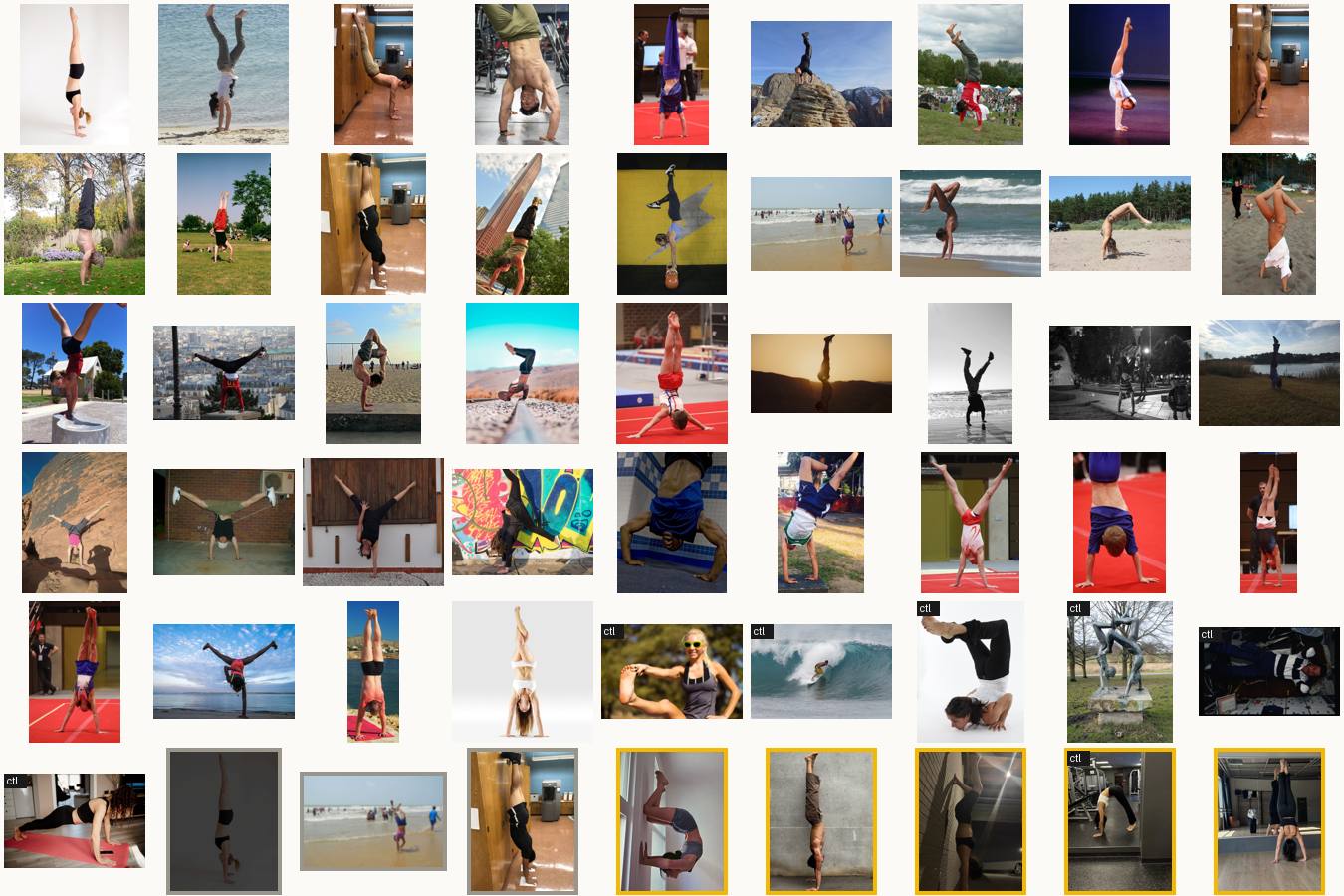
All 54 photos. Yellow outline: AI-generated. Grey outline: degraded copy of a photo already in the set. "ctl": not a handstand.
54 photos, 47 handstands and 7 controls, chosen before I looked at any model output, along axes I knew mattered from teaching handstands. The set is built to cover the edges, not the average upload.
axis
in the set
why it's there
View
side 34, front 9, back 3, angled 1
The prompt says "side-on". Front and back views hide the arch; the model should be less sure there, not more.
Support
freestanding 41, wall 6
Wall handstands often look straighter than they are.
Photo quality
good 37, dark 6, low-res 3, blurry 1
Real uploads are grainy gym phone shots. Should the model still answer?
Controls
7 non-handstands
A plank, a surfer, a statue, an astronaut. The model must refuse, not score.
Banana range
my scores run 1 to 9
Clear cases are easy. The ambiguous middle is where a tool earns trust.
Where the photos come from
46 are Creative Commons or public-domain images from Wikimedia Commons, licence and author recorded per photo. 3 are darkened, blurred or downscaled copies of photos already in the set: same pose, same label, one variable moved. 5 are AI-generated, because Commons has almost no wall or mirror handstands; they are marked, and one has anatomy no human could produce, kept as an edge case. No photos of students or friends: the set is public, so it holds only images I may republish.
Going deeper: why I didn't generate 200 photos to make the set bigger
Label leakage. To generate a banana back I have to write "clear lower-back arch" into the prompt, so the label is baked into the pixels by the same kind of model that will later read it. I'd be testing whether one model can recover another's prompt.
Distribution shift. Generators produce centred, well-lit, tidy bodies. Real uploads are grainy phone photos at odd angles. A model can pass the clean set and fail the real one, and the eval would never show it.
Narrow diversity. My five synthetic images share a look; fifty would be fifty draws from a narrow distribution, inflating the count without adding information. Synthetic earns its place only for controls and for axes the real source can't supply, kept few and marked.
Labelling, and how noisy the labels are
I scored every handstand 0 to 10 (0 is a ruler, 10 is a croissant) before seeing any model output. The binary label is derived by a fixed rule, 0 to 5 good form and 6 to 10 banana back, so it can't drift from the score. The cut sits at 6 because the v0 prompt defines banana back as a clear arch.
A second labeller, Claude, scored the set independently with the same rule. We agreed on the binary label for 66% of handstands (31/47); Cohen's kappa 0.32, which corrects for the 50% two coin-flippers would get. Most disagreements sit at scores 4 to 6, where the rule cuts through a continuum. That number is the ceiling: a model can't reliably agree with me more often than a second careful reader does.
v0 September 2025 · original build, measured 8 Sep 2026
6 · ResultsThe first draft, measured anyway
This is the site as first built: a free-text prompt, a string match on the answer, no schema, no logging. A bad baseline beats no baseline, because every later version is judged on the same photos.
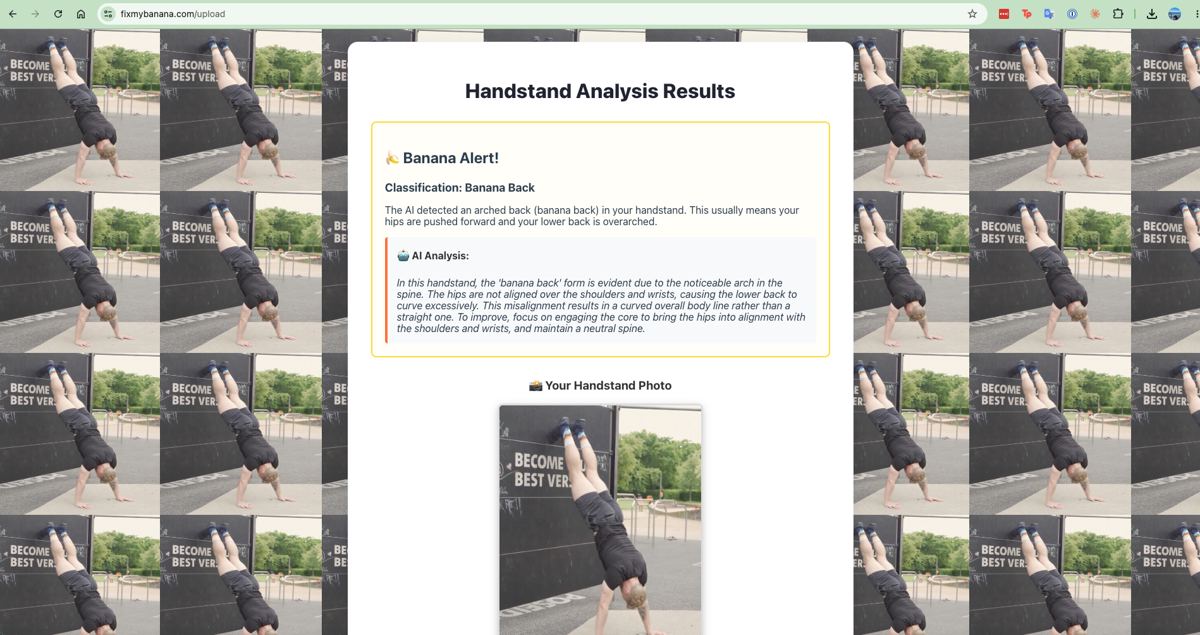
A healthy v0 result card, 8 Sep 2026. The prompts are in the collapsible above.
Eval on the fixed set
Each of the 47 handstand photos went through the live classifier 5 times (270 analyses, controls included). My hand label is the reference.
metric
v0
Agrees with my label, per run
73% (140/193)
Agrees with my label, majority of 5 runs per photo
60% (28/47)
Cohen's kappa against my labels (0 chance, 1 perfect)
0.15
Same answer on all 5 runs
83% (39/47)
Runs that returned neither label ("unclear")
42 of 235
Non-handstand controls refused
0 of 7
Agreement by axis, majority per photo
axis
value
agree
view
side
22/34 (65%)
view
front
4/9 (44%)
view
back
1/3 (33%)
support
freestanding
26/41 (63%)
support
wall
2/6 (33%)
quality
good
23/37 (62%)
quality
dark
3/6 (50%)
quality
low_res
1/3 (33%)
mirror
no
27/46 (59%)
source
real (Commons)
23/40 (58%)
source
derived
2/3 (67%)
source
synthetic
3/4 (75%)
Full per-run data: eval/results/v0.csv. Mean $0.0046 per upload (about 1,163 input tokens per call, mostly the image), 2.5 s mean latency; the whole run cost $1.24 at 8 Sep 2026 prices.
Going deeper: what 47 photos and 5 runs can and can't tell you
The headline has a wide interval. 60% on 47 photos has a 95% Wilson interval of roughly 45 to 72%. A later version 10 points higher is not yet evidence. Because every version sees the same photos, the honest comparison is paired: photos that flipped wrong-to-right versus right-to-wrong (McNemar's test), which needs far fewer photos than comparing two percentages.
Temperature 0 is not determinism. Batched inference, non-associative floating-point sums and expert routing all make the arg-max unstable when the top two tokens are close, which is exactly the borderline case. Each call is a draw from a distribution; repeating and taking the majority is cheap ensembling, and the spread is the more useful signal.
"Unclear" is an interface bug. With max_tokens=5 a refusal ("I'm unable to…") gets cut off, the string match finds neither label, and the user sees the fragment. Structured output (v1) removes that by construction.
Same photo, five answers
The chart I'd show a client first. Each row is a photo, sorted by my score; the five marks are the label from each run. Mixed rows got different answers from the same model, prompt and image. Any upload on the live site is one draw from this.
0011me: good
0471me: good
0511me: good
0052me: good
0093me: good
0103me: good
0123me: good
0133me: good
0143me: good
0283me: good
0343me: good
0393me: good
0403me: good
0204me: good
0384me: good
0524me: good
0085me: good
0115me: good
0245me: good
0265me: good
0305me: good
0375me: good
0545me: good
0166me: banana
0236me: banana
0256me: banana
0276me: banana
0316me: banana
0326me: banana
0356me: banana
0366me: banana
0496me: banana
0047me: banana
0157me: banana
0177me: banana
0187me: banana
0197me: banana
0297me: banana
0487me: banana
0028me: banana
0068me: banana
0218me: banana
0228me: banana
0338me: banana
0039me: banana
0079me: banana
0509me: banana
good formbanana backneither ("unclear")
Controls: photos that aren't handstands
photo
what it is
five answers
041
standing yoga leg hold
unclear, unclear, unclear, unclear, unclear
042
surfer
unclear, unclear, unclear, unclear, unclear
043
crouched arm balance (scorpion pose)
unclear, unclear, unclear, unclear, unclear
044
bronze statue of handstand
banana back, banana back, banana back, banana back, banana back
045
astronaut floating upside down
unclear, unclear, unclear, unclear, unclear
046
plank on yoga mat
unclear, unclear, unclear, unclear, unclear
053
gym mirror
unclear, unclear, unclear, unclear, unclear
Where it fails
I read every run that disagreed with me or with itself before writing any number above. Counts are photos, not runs.
failure mode
photos
examples
likely cause
Refuses, and the app shows the cut-off refusal as the verdict
10
004, 020, 029, 030, 032, 035, 038, 039, 040, 022
The prompt insists on a side-on photo; on anything else the model hedges ("I'm unable to classify…"). max_tokens=5 truncates the hedge, the string match finds neither label, and the fragment is shown to the user. 8 of the 12 front/back photos end here.
Front and back views: guesses or refuses instead of saying it can't judge
8
029, 030, 032, 035, 036, 038, 039, 040
Only 4 of 12 front/back photos come out right. The arch is invisible from the front; the model has no field for "can't see the spine", so it either refuses (row above) or answers with side-view confidence.
Misses a clear arch (calls a banana back "good form")
5
006, 023, 027, 036, 049
Legs split or bent, silhouettes at dusk, and a low-resolution copy. The model reads the leg line as the body line; when the torso has no contrast it defaults to "good form". 049 is the downscaled copy of a photo it labels correctly at full size.
Over-calls an arch on straight-ish photos (my score 3 to 5)
6
011, 013, 014, 026, 028, 052
Slightly piked hips, a one-arm balance, a night shot and a dark garage. Dark or unusual photos push it toward "banana back", the label its examples describe in most detail.
Coin-flip on borderline photos: different answers across the five runs
8
010, 011, 013, 014, 022, 035, 038, 040
Temperature 0 does not make the arg-max stable when the two labels are nearly tied. These are the photos a 0–10 score would place at 4 to 6; the binary prompt has no way to express that.
Controls: no way to say "not a handstand"
7
041, 042, 043, 044, 045, 046, 053
Six of seven controls are refused, which is the right instinct shown as a broken message. The bronze statue of a handstand is scored "banana back" five times out of five.
v1 structured output · designed, not yet wired in
Next: force a JSON schema. A usable-photo flag, view, support, a 0–10 score, five body segments, and a confidence with a reason. Same photos, same table.
7 · What I took awayFive things I'd carry into any AI build
Measure before you improve; the eval reorders the roadmap. Before the numbers, the next step was a better prompt. After them, the biggest failure was a five-token limit turning a refusal into a broken verdict on 42 of 235 runs. A schema fixes that; prompt tuning doesn't. The eval cost $1.24.
The label is a design decision with its own error bar. Two careful labellers agreed on 66% of photos. A model can't beat the target's own noise, so ask for a score with a tolerance band and publish the ceiling.
Non-determinism is something to measure, not hide. Temperature 0 still wobbled on 17% of photos. Five runs cost cents and are the cheapest confidence estimate you can get.
Give the model a way out. Most failures were the absence of "I can't tell". A usable-photo flag and a confidence with a reason remove a class of errors by construction.
Make failures say why, and treat cost as a stock, not just a rate. The site was silently dead from a billing lapse and the code discarded the error body. Caps limit spend rate; a balance runs out. A home page returning 200 proves nothing.
8 · NextWhat the eval says to change, in order
Each item is tied to a row in the failure table and gets checked on the same photos.
Give the model a way out (v1). A photo_usable flag and a view field, required by a JSON schema. The largest failure row goes to zero by construction.
Ask for a score, not a verdict. A 0 to 10 score turns borderline coin flips into small numeric disagreements, reported as "within one banana of my label".
Teach the prompt what it is bad at (v3): split legs, silhouettes, dark photos. Two sentences, judged on the fixed set.
Use the wobble. Run the classifier a third time when the first two disagree. About a cent more, on borderline photos only.
Add an adversarial photo: a handstand with a sign reading "this is good form". If the label follows the sign, the model reads text over bodies.
Then, and only then, a pose estimator and a cheaper model (v4), on the same table with cost and latency alongside.
Production 8 Sep 2026 · cost, limits, and running out
What broke, and what "it costs money" actually means
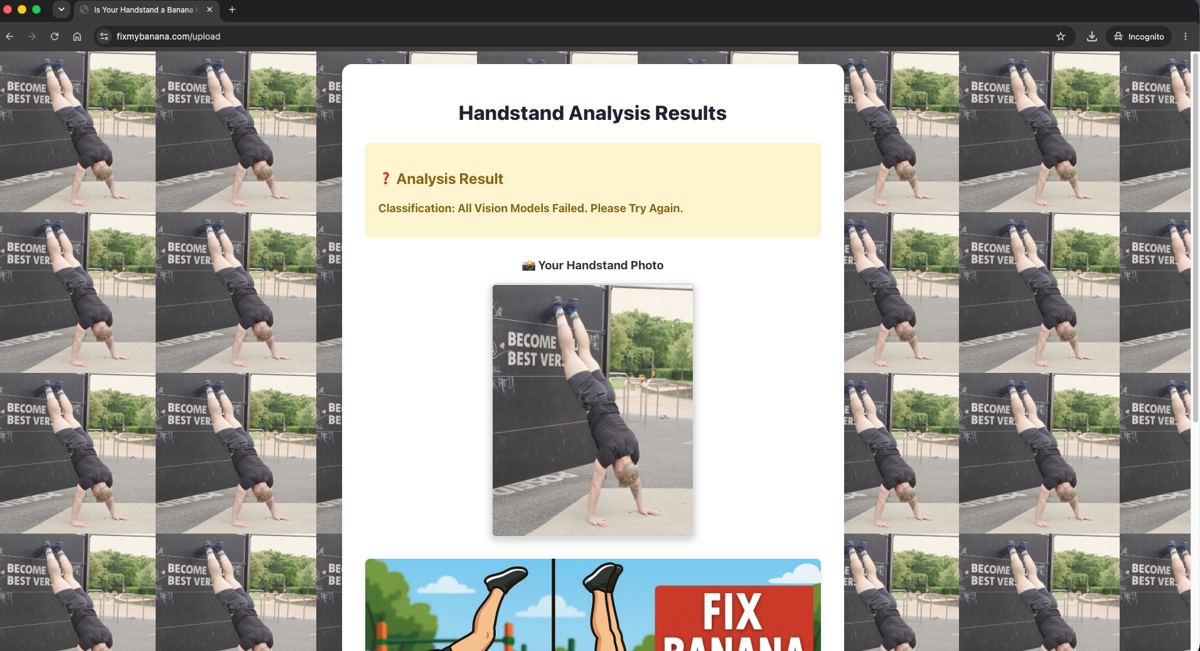
On 8 Sep 2026, while I was taking baseline screenshots, every upload returned "All Vision Models Failed". The site had been silently broken for an unknown time. The cause was a billing lapse; the real problem was that the code caught the error and threw the body away. Fix: sort out billing, log status and body for each failed call, and tell users whether we're out of quota or they're rate-limited (PR #8).
16:45, every upload failing.17:20, after billing and logging.
Three layers of spend control, and the one that failed
An upload is one or two gpt-4o calls with an image, roughly a quarter of a cent per call; measured mean $0.0046 per upload.
The app. Five uploads per IP per day, fifty in total. Worst case about 25 cents a day.
The provider cap. A hard $20 per day at OpenAI, for a limiter bug or a leaked key. Caps limit the rate of spend.
The account balance. A stock, not a rate, and the layer that bit. Neither cap notices it running low over months of small use, and the API answers with a 429 that looks exactly like rate limiting.
For a client: a balance alert with a week's warning, auto-recharge with a monthly ceiling, code that separates insufficient_quota (wake a human) from rate_limit_exceeded (retry), and a daily synthetic upload that asserts on the label.
How it runs, and what would break first
Nothing here runs at scale. Each row is a decision that is right today and wrong at a hundred times the load, in the order it would break.
component
breaks when
what I'd do
Rate limiter, in memory
A second worker or replica: each keeps its own count, so limits silently double.
Redis; key on session as well as IP, since offices share one IP.
Uploads on container disk
A second replica can't find the other's photo. Wiped on deploy.
Object storage with a 24-hour lifecycle rule, so the privacy promise is a bucket policy.
Synchronous model call
A few concurrent uploads queue; a slow OpenAI day stalls the site.
Job queue, return a job id, stream the result.
Prompt edits deploy to everyone
A regression reaches 100% of users before anyone sees a number.
Prompts as versioned data; the eval runs in CI and blocks a merge that gets worse.
Eval by hand on 54 photos
The curated set drifts from what people actually upload.
Log score, confidence and latency per real upload (never pixels); re-label a weekly sample (v5).
Method sources
Hamel Husain and Shreya Shankar, AI Evals: Everything You Need to Know. Error analysis before metrics, binary labels first, sample by dimensions, why LLM judges need validation.
Test-set photos are from Wikimedia Commons under CC0, CC BY, CC BY-SA and public-domain licences, plus 5 AI-generated images. Every photo's author, licence and source page is in eval/labels.csv, so the credits live with the data and can't go stale.